Average Reviews:

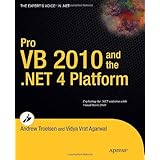
(More customer reviews)Are you looking to buy Pro VB 2010 and the .NET 4.0 Platform (Expert's Voice in .NET)? Here is the right place to find the great deals. we can offer discounts of up to 90% on Pro VB 2010 and the .NET 4.0 Platform (Expert's Voice in .NET). Check out the link below:
>> Click Here to See Compare Prices and Get the Best Offers
Pro VB 2010 and the .NET 4.0 Platform (Expert's Voice in .NET) ReviewSince I often read Amazon reviews to decide what to buy, I thought I would contribute a review of this book. First, I have experience in both VB.NET and C#, and I have been testing VB.NET 2010 for myself since it was in Beta (and absolutely loving it!). I wanted to get a really good reference book on VB.NET 2010, so I preordered this one on Amazon based on my like for the book "Pro C# 2010 and the .NET 4 Platform" written by the same author as this book, Andrew Troelsen.I want to start this review by going over all my criticisms. First, the book was delayed by about a month (so I waited for my preorder much longer than I anticipated), and to be completely blunt, it should have been delayed by the publisher for a little longer to allow for more polish by the author. To be specific, there are many places in the book with horrible grammar. For example, Chapter 3 of the book is a polished, generally well written chapter. Chapter 25, on the other hand, has grammar that progressively gets worse throughout the chapter.
The code samples could have used some polish too. There are a couple of the predictable spell-checker errors in code (Eg: "For Each I As Integer in myInts" when the author meant "For Each i As Integer In myInts" -- p.138). Also, some of the code samples have awful (unintended by the author) formatting (Eg: The location of "For i=0 To 5" in the sample on p.185).
Finally, the author commits, a couple times, the most annoying error possible in a VB.NET book (in my opinion). The error is to copy/paste C# remarks and code into a VB.NET book, but not convert them to VB. A good example of this egregious error occurs on p.232 regarding inheritance in VB. The author says:
"As you would guess, there are many more details to inheritance that you will come to know during the remainder of this chapter. For now, simply keep in mind that the colon operator allows you to establish base/derived class relationships..."
Hmm, no colon operator in VB for inheritance....
Having said everything above, a reader of this review might think I hate the book. Absolutely not! To the contrary, I love the book, and I am giving it a full five stars. While I find grammar errors annoying, I didn't buy the book to be a fine piece of literature. The book description clearly states it is intended for an audience with some experience in programming, and such an audience will easily recognize and easily overcome any of the small coding and formatting errors in the examples. Finally, the occurrences of C# in the book are exceedingly rare, and I suspect they will be easily recognized by the intended audience.
I did buy this book for content, and it is with the content that this book absolutely shines. The content of the book is well planned, and proceeds in a logical fashion. The explanations given in the book are excellent, and the purpose of the code samples are always clear (and there are tons of code samples). Above, I mentioned the poor grammar of Chapter 25. Nonetheless, the chapter, which introduces the reader to WCF, gives the best and clearest introduction to WCF from a VB standpoint that I have read anywhere, and I truly appreciate the chapter (I would have even loved to see more on WCF).
I would absolutely recommend this book to any programmer serious in VB.NET. I consider it an invaluable resource, and I always have it handy as I am programming. I also consider it an absolute steal for less than $40 on Amazon.
Does the book cover everything? At about 1800 pages, it gets close - check the book contents for yourself. There are inevitably things that are left out. One of my favorite features in VB.NET 2010 is XML literals (this is not a feature of C#). Combining XML literals with Linq is very briefly mentioned in the book, and at that, the book does not address the really cool advantages of this VB only language feature. Rather, the author approaches XML and Linq in a fasion similar to what would be done in C#, which is a shame. Nonetheless, the book would definitely leave the reader prepared to learn more about this feature (for example, see the video "How Do I: Get Started with LINQ to XML?" at the Visual Basic Developer Center), and for that I give the book credit.
Bottom line is this: The book is fantastic, and in my opinion, it is the best VB book out there. It isn't perfect - no book could be, and the imperfections of this book are easily overlooked. I think the book is a steal for its price, and it is the book I think a VB 2010 programmer should have handy and at his/her side.Pro VB 2010 and the .NET 4.0 Platform (Expert's Voice in .NET) Overview
Be the first to understand .NET 4.0 and Visual Basic 2010. Pro VB 2010 and the .NET 4.0 Platform provides developers with a complete guide to the new technology, explaining the importance of all the key VB 2010 language features. This edition has been comprehensively revised and rewritten to make it accurately reflect the VB 10 language specification for the .NET 4.0 platform. You'll find new chapters covering the important concepts of dynamic lookups, named and optional arguments, Parallel LINQ (PLINQ), improved COM interop, and variance for generics.
The first edition of this book was released at the 2001 Tech-Ed conference in Atlanta, Georgia. At that time, the .NET platform was still a beta product, and in many ways, so was this book. This is not to say that the early editions of this text did not have merit-after all, the book was a 2002 Jolt Award finalist and it won the 2003 Referenceware Excellence Award. However, over the years that author Andrew Troelsen spent working with the common language runtime (CLR), he gained a much deeper understanding of the .NET platform and the subtleties of the VB programming language, and he feels that this sixth edition of the book is as close to a "final release” as he's come yet!
If you're checking out this book for the first time, do understand that it's targeted at experienced software professionals and/or graduate students of computer science (so don't expect three chapters on iteration or decision constructs!). The mission of this text is to provide you with a rock-solid foundation in the VB programming language and the core aspects of the .NET platform (assemblies, remoting, Windows Forms, Web Forms, ADO.NET, XML web services, etc.). Once you digest the information presented in these 25 chapters, you'll be in a perfect position to apply this knowledge to your specific programming assignments and explore the .NET universe on your own terms.
What you'll learn
Discover the ins and outs of the leading .NET technology.
Learn from an award-winning author who has been teaching the .NET world since version 1.0.
Find complete coverage of the WPF, WCF, and WF foundations that support the core .NET platform.
Who this book is for
This book is for anyone with some software development experience who is interested in the new .NET Framework 4.0 and the VB language. Whether you are moving to .NET for the first time or are already writing applications on .NET 2.0 or .NET 3.5, this book will provide you with a comprehensive grounding in the new technology and serve as a complete reference throughout your coding career.
Table of Contents
Introducing VB 2010
Building Visual Basic 2010 Applications
Core VB 2010 Programming Constructs, Part I
Core VB 2010 Programming Constructs, Part II
Defining Encapsulated Class Types
Understanding Inheritance and Polymorphism
Understanding Structured Exception Handling
Understanding Object Lifetime
Working with Interfaces
Understanding Generics
Delegates, Events, and Lambdas
Advanced VB 2010 Language Features
LINQ to Objects
Configuring .NET Assemblies
Type Reflection, Late Binding, and Attribute-Based Programming
Processes, AppDomains, and Object Contexts
Understanding CIL and the Role of Dynamic Assemblies
Dynamic Types and the Dynamic Language Runtime
Multithreaded and Parallel Programming
File I/O and Object Serialization
ADO.NET Part I: The Connected Layer
ADO.NET Part II: The Disconnected Layer
ADO.NET Part III: The Entity Framework
Introducing LINQ to XML
Introducing Windows Communication Foundation
Introducing Windows Workflow Foundation 4.0
Introducing Windows Presentation Foundation and XAML
Programming with WPF Controls
WPF Graphics Rendering Services
WPF Resources, Animations, and Styles
WPF Control Templates and UserControls
Building ASP.NET Web Pages
ASP.NET Web Controls, Master Pages, and Themes
ASP.NET State Management Techniques
Programming with Windows Forms
Platform-Independent .NET Development with Mono
Want to learn more information about Pro VB 2010 and the .NET 4.0 Platform (Expert's Voice in .NET)?
>> Click Here to See All Customer Reviews & Ratings Now

0 comments:
Post a Comment