Average Reviews:

(More customer reviews)Are you looking to buy Beautiful Testing: Leading Professionals Reveal How They Improve Software (Theory in Practice)? Here is the right place to find the great deals. we can offer discounts of up to 90% on Beautiful Testing: Leading Professionals Reveal How They Improve Software (Theory in Practice). Check out the link below:
>> Click Here to See Compare Prices and Get the Best Offers
Beautiful Testing: Leading Professionals Reveal How They Improve Software (Theory in Practice) ReviewThis is a great book for testers, leads, and managers to read to get a better picture of where your testing process can bring value to your work. A few sections of this book didn't get me much value, but the vast majority of the book left me frantically scratching notes and folding corners of pages over. I read the book over a weekend and came away with a large number of major additions to my QA roadmap I use at work.Kamran Khan's chapter on fuzz testing reinforced my ideas that choking your system with invalid parameters and input data is a tremendous way to shore up that system's stability. I also really enjoyed Lisa Crispin's and Alan Page's separate chapters, both of which emphasized value-driven, sensible approaches to test automation.
If you want an amazing story around how testing can directly impact the lives of those around you, read Karen Johnson's chapter "Software in Use." Johnson ties a visit to an Intensive Care Unit to work she'd done on equipment in that ICU - it's rare anyone sees that practical a link to work we do in this industry.
Other highly worthwhile chapters include the piece on Python's development process, the overview on TDD, Mozilla's regression testing philosophy, and others. The Python chapter, in particular, is a tremendous testament to how a rigorous testing philosophy can guarantee very solid releases even with a broad, distributed team of varying skills.
As my examples above point out, there's a great amount of broad-stroke value in the book; however, a wealth of smaller, critical points abound in various chapters as well. Some weren't phrased exactly like this, but I've taken away these other concept as well:
* Track the source of your bugs (test plans, exploratory, developer, etc.) and pay special attention to bugs found by customers. These "escapees" point to areas to shore up in your test plan.
* Mindmaps are a great way to brainstorm out your test plan or test areas.
* Use small tools like fuzzers to help create your baseline input data.
* 100% passing rates for your automated tests isn't reasonable. Investigating 100% of your failing tests to determine whether the specific failure matters is reasonable. (I already firmly believed this, but it was nice to see in print!)
* Using image comparison to check formatting.
This is one of the better books I've read this year, and it's absolutely worth adding to your shelf.
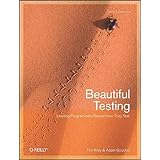
Beautiful Testing: Leading Professionals Reveal How They Improve Software (Theory in Practice) OverviewSuccessful software depends as much on scrupulous testing as it does on solid architecture or elegant code. But testing is not a routine process, it's a constant exploration of methods and an evolution of good ideas. Beautiful Testing offers 23 essays from 27 leading testers and developers that illustrate the qualities and techniques that make testing an art. Through personal anecdotes, you'll learn how each of these professionals developed beautiful ways of testing a wide range of products -- valuable knowledge that you can apply to your own projects. Here's a sample of what you'll find inside:
Microsoft's Alan Page knows a lot about large-scale test automation, and shares some of his secrets on how to make it beautiful
Scott Barber explains why performance testing needs to be a collaborative process, rather than simply an exercise in measuring speed
Karen Johnson describes how her professional experience intersected her personal life while testing medical software
Rex Black reveals how satisfying stakeholders for 25 years is a beautiful thing
Mathematician John D. Cook applies a classic definition of beauty, based on complexity and unity, to testing random number generators
All author royalties will be donated to the Nothing But Nets campaign to save lives by preventing malaria, a disease that kills millions of children in Africa each year. This book includes contributions from:
Adam Goucher
Linda Wilkinson
Rex Black
Martin Schröder
Clint Talbert
Scott Barber
Kamran Khan
Emily Chen
Brian Nitz
Remko Tronçon
Alan Page
Neal Norwitz
Michelle Levesque
Jeffrey Yasskin
John D. Cook
Murali Nandigama
Karen N. Johnson
Chris McMahon
Jennitta Andrea
Lisa Crispin
Matt Heusser
Andreas Zeller
David Schuler
Tomasz Kojm
Adam Christian
Tim Riley
Isaac Clerencia
Want to learn more information about Beautiful Testing: Leading Professionals Reveal How They Improve Software (Theory in Practice)?
>> Click Here to See All Customer Reviews & Ratings Now

0 comments:
Post a Comment