Average Reviews:

(More customer reviews)Are you looking to buy Semantic Web Programming? Here is the right place to find the great deals. we can offer discounts of up to 90% on Semantic Web Programming. Check out the link below:
>> Click Here to See Compare Prices and Get the Best Offers
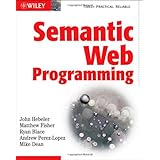
Semantic Web Programming ReviewThis book will help you acquire knowledge or skills in: the Semantic Web approach to Information Modeling, the use of rules to augment such models when needed, where to find data sets already formatted for Semantic Web usage or ontologies that you could adapt for your application if you don't want to create one from scratch, how to interrogate the Semantic Web using special browsers or browser plugins, search engines, or a query language such as SPARQL, how to use an open-source tool such as Protege from Stanford University to create Semantic Web Information Models, an open-source reasoning engine like Pellet for making inferences flowing from your data sets, and an open-source development framework like Jena from Hewlett Packard for creating Semantic Web applications.This is not the only book written for software developers but it is the best available so far, especially if you are a Java Developer. Toby Segaran et al's "Programming the Semantic Web" uses Python as the main programming language and has more limited coverage of Semantic Web topics. Both books, however, are quite readable even if you are not a programmer. If you're really looking to learn just the concepts, however, you might want to consider "A Semantic Web Primer 2nd Edition" by Grigoris Antoniou and Frank van Harmelen, or "Introduction to the Semantic Web and Semantic Web Services" by Liyang Yu, instead.
I like this book very much not only because it is very well-written and thought out, but also for its up-to-date and broad coverage. It covers Version 2 of the Web Ontology Language used for Information Modeling, so new features such as property chains, keys, and custom data types are discussed. It has a good tutorial on SPARQL, and the chapter on Patterns and Best Practices include architectural recommendations and useful tips for managing URIs and annotations. It provides references to important concept papers, and to popular open-source and commercial tools.
I do hope that future editions of this book will include: more concrete discussions of the challenges involved in modeling and using Semantic Web data due to the paradigm's adherence to the Open World rather than the Closed World Assumption, and recommendations on potential approaches to model versioning and addressing security concerns such as role-based viewing of Semantic Web data. Overall, however, an excellent book!Semantic Web Programming OverviewThe next major advance in the Web?Web 3.0?will be built on semantic Web technologies, which will allow data to be shared and reused across application, enterprise, and community boundaries. Written by a team of highly experienced Web developers, this book explains examines how this powerful new technology can unify and fully leverage the ever-growing data, information, and services that are available on the Internet. Helpful examples demonstrate how to use the semantic Web to solve practical, real-world problems while you take a look at the set of design principles, collaborative working groups, and technologies that form the semantic Web. The companion Web site features full code, as well as a reference section, a FAQ section, a discussion forum, and a semantic blog.
Want to learn more information about Semantic Web Programming?
>> Click Here to See All Customer Reviews & Ratings Now

0 comments:
Post a Comment